A File is a bunch of bytes stored on some storage device like magnetic disk or tape etc. Most of the application programs process large volume of data which is permanently stored in files. We can write programs that can read data from file(s) and write data to file(s).
Polymorphism is made from two words POLY+MORPHISM which means more the one form. In C++ polymorphism is implemented by overloading a function or an operator. In Function Overloading a single function name is used to perform different tasks.
In C++, a class only creates a data type and the objects of a class are created and initialized as separate. A constructor (having the same name as that of a CLASS) is a member function which is automatically used to initialize the objects of the CLASS type with legal initial values.
A Friend Function is a non-member function that can access private data’s. A friend CLASS is a class whose member functions can access another class i.e. private and protected classes.
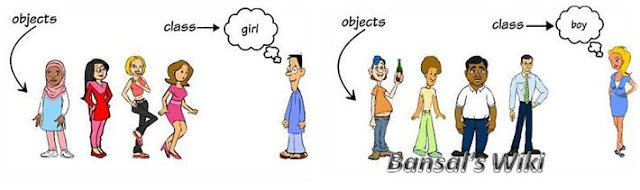
“C with classes” was the original name given by the originator Stroustrup initially, which now days is popular known form as C++ or OOPs (Object Oriented Programming). Classes and objects are the most important feature of C++. The Class implements OOPs features and ties then together. We have already seen that a structure groups different types of elements and a function organizes the program actions to perform the desired task.
Some standard manipulators are used in C++ (OOPs) which are stored under header file iomanip.h. Under this it has capabilities to show inter-conversions like binary, decimal, hex-decimal, set the precision for more accurate answer and various other functions like you can see in the programs.
Structure is the user defined data type which can store heterogeneous data i.e. data of different types. It means in structure member with all possible data type can be used and there is no restriction that elements of the structure are stored at adjacent memory locations. Structure is declared with key word struct followed by its name and then by block.
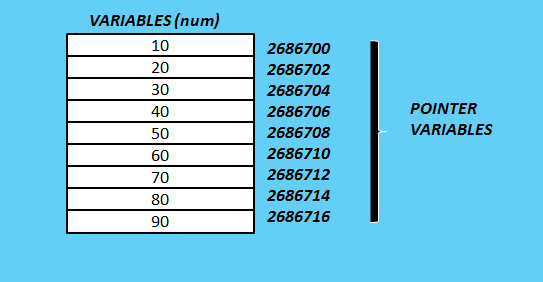
Pointer is that variable which stores the memory address of another variable. It means pointer is itself a variable which stores hex-decimal address of the location.
Array is an arrangement of same type of data at adjacent memory locations. Array is useful whenever large volume of data is to be processed and stored in the memory.
Suppose an average marks are to be calculated from all the students in the school. This is difficult to find the sum of marks of all students. In this situation an array is the best alternative. Its divided in two categories:
1. Single / 1-D Array
2. Multi-dimension Array
/* Program to enter order of the matrix and print stars*/
#include<iostream.h>
#include<conio.h>
main()
{
int m,n,i,j;
cout<<"\n Enter order of Matrix m*n";
cin>>m>>n;
cout<<"\n";
for(i=0;i<m;i++)
{
for(j=0;j<n;j++)
{
cout<<" *";
}
cout<<"\n";
}
getch();
}
“for” loop is also structure control loop as program will run or execute if the initial condition is true otherwise it will terminate and program will run until some condition is fulfilled.
FORMAT:for(expression1;expression2;expression3){Statement1;Statement2;}
This statement can be used to select any one statement or a block which contains a set of instructions. Only that statement will execute which is true according to the data entered and rest other conditions will not executed.
This statement is also a conditional statement. It starts with keyword ‘if’ followed by an expression followed by “ first statement” and “ second statement” is given after ‘else’ clause.
Format:if(expression)statement1;elsestatement2;
It is used whenever any condition is to be implemented by the user it means some conditions like:1. If the price of the item is more than 5000 then discount is 10%.2. If the students marks are greater than 60% then he should be in 1st division.
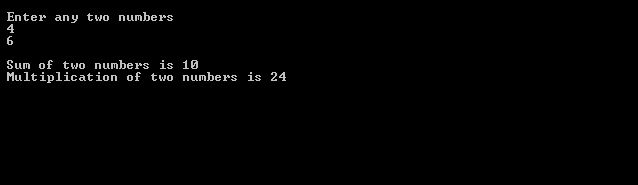
/* Program to enter two values and perform addition and multiplication operation*/
#include<iostream.h>
#include<conio.h>
main()
{
int n1,n2,sum,mul;
cout<<"\n Enter any two numbers";
cin>>n1>>n2;
sum=n1+n2;
mul=n1*n2;
cout<<"\n Sum of two numbers is "<<sum;
cout<<"\n Multiplication of two numbers is "<<mul;
getch();
}
A file is a place on the disk where the group of related data are stored. The first function is to be performed when we are accessing the files is to open a file. Opening a file establishes a link between the program and the operating system about which file we want to access for what purpose. We provide the operating system to which file we want to access and for what purpose. For accessing a file we just have to name the file and plan whether we want o read data from the file or write data onto the file. The syntax for opening is:
FILE *fp;
inbuilt structure
fp= fopen( “file name”, “mode”);